


Planning Applications
After our initial survey, together with your brief we will produce a first draft of our proposal. Firstly with your rquirements in mind, but with an "eye" on the Planning rules that particularly apply in your situation.
After the final design has been prepared and agreed the next stage will be to apply for Planning Permission.
The law that governs Planning is quite complex, but in principle is easy to understand. It basically gives a very broad all encompasing definition of development. And then states that all development needs consent.
Now if it just stopped there, Planning Permission would be needed literally for everything from a hole in the ground to bean pole in the garden.
The next thing the Government did was to exempt certain minor works form the need to apply for Planning Permission by regulations. What these document effectively did was to grant Planning Permission by comlying with them.
These documents are the General and Special Development Orders and a brief interpretted extract is shown on this page.
These regulations have been effectionately named your "Permitted Development Rights". So far so good.
However, some newer, especially high density estates have had their Permitted Development rights removed by Planning Condition attached to the original development.
Elvetham Heath for example has large parts of the development where some or sometimes all of their Permiitted Development rights have been removed.
The reason for this, amonst others, was the original design was already very dense with limited off street car parking.
Therefore, if a high proportion were to exercise their rights, and say convert their garages into dining rooms the resultant off street parking may resut in large vehicle movements being restricted.
So, to sum up. Permitted Development generally removes the necessity for full Planning Permission, but not always. The answer to the whether the property has or has not Permitted Development rights will be found in the original Planning Consent for the building or development. Remember, it must be specifically removed by condition.

Pre Planning Advice
There are two situations where adopting this approach would be prudent. Firstly, in the event that your proposal falls outside the adopted policies of the Local Planning Authority. Secondly, although we may be sure your proposal is within your "Permitted Development rights",we may not be sure if your rights have been removed by Planning Condition on the original consent.
In either of these cases we may need enter into discussions with the Local Planning Authority by requesting "Pre Planning Advice".
Full Planning Permission or Permitted Development?
Subject to issues that relate to Permitted Development Rights that are explained over, by the time a Planning Application is necessary we will know whether to apply for Planning Permission of a Lawful Development Certificate.
A Lawful Development Certificate is the consent we apply for in the event we consider the project "Permitted Development". The reason we will always obtain this certificate on your behalf is to protect you from any unecessary delays when you come to sell your property. This ensures that when you hand your documentation over to your Solicitor, all your ducks are in a line and there are no last minute problems that could loose or delay your sale.
So in simplistic terms if your proposal is Permitted Development we apply for a "Lawful Development Certificate", if not we apply for "Planning Permission"
If Planning Permission is required it will be judged against the Councils Planning Policies that a relevant to your proposals. These policies are relatively consistant thoughout the Country with the emphasis varying depending upon location.
Click on the link below "to show Planning Considerations" to give you a brief indication of what your Planning Application will be judged against.
Set out below is a brief simplistic list of the type of work that is Permitted Development and would require the benefit of a Lawful Development Certifcate.
- No more than half of the land surrounding the original house should be covered by additions or other buildings
- Your extension should not be higher than the highest part of your property's roof
- If your extension is to be built at the rear and is one storey high, it must have a maximum depth of 3m for an attached house and 4m for a detached house (Measure the depth from the rear wall of your property)
- The maximum height of your extension at the rear should be 4m
- If you are planning to build an extension of more than one storey, the maximum depth to go for is 3m from the rear wall of the property and including the ground floor
- The maximum eaves height of your extension should be 3m when it's built, and within 2m of your property's boundary
- The maximum eaves and ridge height of your extension should be no higher than your existing property
- If you wish to build a single storey side extension without planning permission you need to opt for a maximum height of 4m and with a width of no more than half that of your existing property
- Any two-storey extension should reach no further than 7m to the rear boundary of your property
- The roof pitch on any extension higher than one storey, should match the pitch of your existing home
- Opt for an extension built with similar materials and a similar appearance to your existing home
- The extension should not have any verandas, balconies or raised platforms
- If you are building in upper floor or side-facing windows, they should be obscure-glazed and any opening of this kind should be 1.7m above the floor

This property had been converted in the 70’s to look like a house from the front, and a bungalow from the rear. Our design involved removing the existing low pitched roof and replacing it with a traditional plain tile roof with a room located within. The garage was converted into living space and a detached garage was constructed. The result – a very desirable, attractive and modern property.
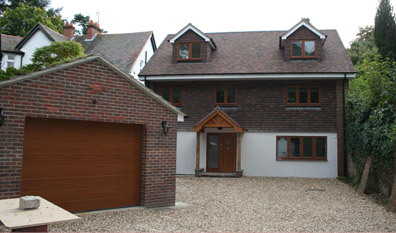
new front view
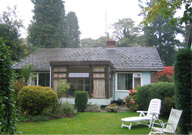
original rear view
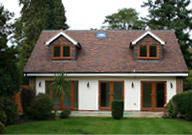
new rear view

original front view

drawing plan of Ford Lane
(click image for larger view)